A honing rod and a sharpening stone do different jobs: the steel rod realigns the edge of the blade, while the stone removes material to rebuild it. If you want to maintain a knife that still cuts well, start with a honing rod suited for the blade. If it no longer cuts efficiently, you need sharpening. Below you will find the differences between the two tools and how to pick the right one.
Honing rod or sharpening stone: what is the difference?
| Honing rod | Sharpening stone | |
|---|---|---|
| What it does | Realigns an edge that has bent | Forms a new edge |
| Removes material | Little or none, depending on the type | Yes, a fine layer of steel |
| How long it takes | Ten, fifteen seconds | From a few minutes upwards |
| How often | Every few uses | Once or twice a year |
| Helps a knife that is already dull | No | Yes, that is what it is for |
A steel honing rod realigns the edge that bends during use. Through repeated cutting, the edge of a blade curves slightly to one side without losing material. That is why the knife feels dull even though the steel is still there. The rod is applied at an angle slightly wider than the edge itself, which reforms the fine edge, according to the technical documentation on honing steels.
Sharpening works differently. It rebuilds the edge of a dull blade, and in the process steel is actually removed, a fine layer from which a new edge is formed. This is why sharpening calls for a material harder than the steel of the blade, such as stone or ceramic.

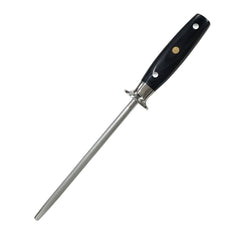
How to use a honing rod. Hold the rod upright, with the tip resting on a stable surface. Draw the blade lightly along the rod, from heel to tip, keeping a constant angle in line with the angle recommended for that blade. Alternate sides and make a few light passes on each. Do not press hard. The diagram above shows 20 degrees, a common reference point for European blades, but check what the maker of your knife recommends.
One detail clears up the most frequent confusion: a classic smooth rod does not help a knife that is already dull, because it removes no material. It only corrects the deformation of a blade that is still sharp.
How to choose between a honing rod and a stone
You get the answer in a few seconds, with no instruments at all. Put the blade on the skin of a tomato and press lightly.
- The blade goes in, but not as cleanly as before: you need a honing rod. The edge has bent, it has not worn down.
- The blade slides across the skin instead of going in: you need a stone. The edge has lost material, and a rod has nothing left to realign.
- The edge has visible chips: a stone again, starting with a coarse grit, around 400.
Beyond the test above, the criteria break down like this:
- Steel honing rod: for the regular maintenance of compatible knives, blades that benefit from having the edge realigned.
- Diamond honing rod: for abrasive maintenance and the removal of a small amount of material, used with care.
- Sharpening stone: for rebuilding the edge when ordinary maintenance is no longer enough.
- Knives with very hard blades or a special geometry: check the maker's recommendations before choosing the tool.
The choice is not made on the hardness of the steel alone. The geometry of the blade, the type of edge and the maker's instructions all count. This is also the place for a word about pull-through sharpeners: some can remove too much material or be unsuitable for the geometry of certain blades, so check first what the maker of your knife recommends.
The practical rule stays simple: hone often, sharpen rarely. A knife maintained every few uses reaches the stone far less often. Wüsthof, one of the major German makers, recommends in its own sharpening guide honing at short intervals and sharpening once or twice a year, depending on how heavily the knife is used.
Types of honing rod: steel, diamond and ceramic

Not all honing rods do the same thing, and this is where the most common buying mistake happens. The difference lies in the material.
| Type | What it does | When to use it |
|---|---|---|
| Steel, with ridges | Realigns the edge, removes very little material | Regular maintenance, on compatible knives |
| Diamond | Realigns and removes material, it is abrasive | When the blade needs more than a realignment |
| Ceramic | Realigns and refines the edge | Fine finishing, on blades that call for it |
Steel and ceramic rods usually have lengthwise ridges, while diamond rods are smooth but carry abrasive particles on the surface. That explains why a diamond rod behaves more aggressively: every pass takes off a little steel, so it also reaches a blade that a classic rod can no longer bring back.
From our range:
- Professional honing rod S6: for the regular maintenance of compatible knives.
- Diamond honing rod S7: for abrasive maintenance of the blade, when a small amount of material needs to come off.
We do not carry a ceramic rod, so if you need one, you will have to look elsewhere.
How to choose the grit of a sharpening stone

The grit decides what you get. A 400 stone removes material and rebuilds a chipped edge. 1,000 is the working grit, the one you come back to most often. Fine grits, from 3,000 upwards, refine the edge and can improve its finish.
Sharpening removes material, which is why it is better done only when it is needed. If you are buying a single set, choose one that covers both the working grit and a finishing grit.
- Professional sharpening kit S3: grits 400, 1,000, 3,000 and 8,000, covering the whole road from repair to finishing.
- Professional sharpening kit S4: grits 1,000 and 6,000, the shorter option, for maintenance.

How to use a sharpening stone. Prepare the stone according to the maker's instructions and set it on a stable surface. Draw the blade across the stone, holding the same angle along the whole length of the edge. Work both sides of the blade, then move to a finer grit for finishing.
Frequently asked questions
What is the difference between a honing rod and a sharpening stone? The rod realigns an edge that has bent, the stone forms a new edge by removing material. The first is used often, the second rarely.
Can a diamond honing rod sharpen a dull knife? Partly. Being abrasive, it removes a little material on every pass, so it helps a tired blade more than a classic rod does. For an edge that is fully dull or chipped, the stone remains the answer.
What grit should a sharpening stone have? 1,000 for ordinary maintenance, around 400 when the edge is chipped and has to be rebuilt, 3,000 or higher for finishing. A set covering two of those is enough at home.
How often should kitchen knives be sharpened? Once or twice a year for a knife used daily and honed regularly. The clear signal is still the tomato test.
Sources
- Wüsthof, sharpening guide: the recommended rhythm, honing often and sharpening once or twice a year.
- Technical documentation on honing steels: the materials used, the lengthwise ridges and the fact that a smooth rod removes no material.
Not sure which tool you need? Both of them, rods and stones, browse our knife sharpeners collection, with the grits listed on every set.
For the rest of the care, from storage to washing, the steps are gathered in the article on the most common mistakes people make with kitchen knives.